How does STAMM work?#
Imagine an industrial process, a reactor, a fermentation tank, a production line. Some important variables can be measured easily, but others are too slow, too expensive, or physically impossible to measure continuously. This is where soft sensors come in: they estimate these hidden variables using data from available measurements.
Soft sensors are usually developed by process engineers, data scientists, or technology providers using legacy data. STAMM does not build these models.
Instead, STAMM takes already-developed soft sensors and focuses on what happens after they are deployed in real operations.
Step 1: Deploying soft sensors into real processes#
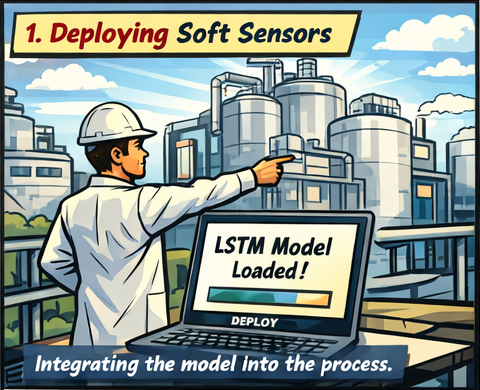
Once a soft sensor is deployed, it becomes part of the daily operation, much like a physical instrument. However, unlike hardware sensors, soft sensors depend on assumptions about process behavior that may not remain valid forever.
STAMM provides the framework to safely integrate these existing soft sensors into live systems, treating them as operational assets rather than static models.
Step 2: Watching the soft sensor in real time#
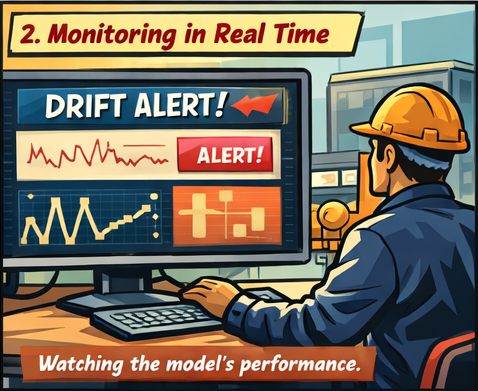
STAMM continuously observes how the deployed soft sensor behaves.
Instead of assuming it will remain accurate indefinitely, STAMM treats it as a living component of the process.
It monitors:
whether incoming process data still look familiar,
how stable the operating conditions are,
and how the soft sensor’s outputs evolve over time.
This is similar to how experienced operators notice subtle changes in a plant before formal alarms are triggered.
Step 3: Detecting when the process is changing#
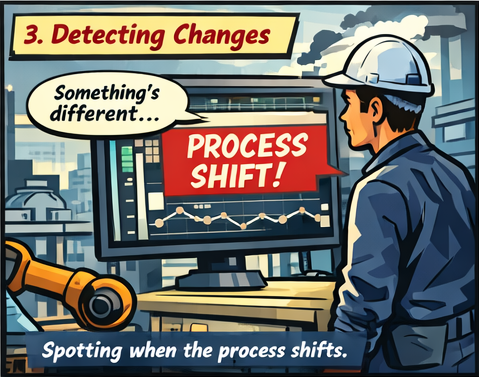
Industrial processes evolve: raw materials vary, equipment ages, control strategies are updated.
When these changes occur, the soft sensor may still produce numbers — but those numbers may no longer be trustworthy.
STAMM identifies these situations by detecting:
shifts in operating regimes,
gradual or sudden process drift,
mismatches between current conditions and those seen during model development.
From a digital twin perspective, STAMM checks whether the digital representation remains aligned with the physical process.
Step 4: Deciding when maintenance is needed#
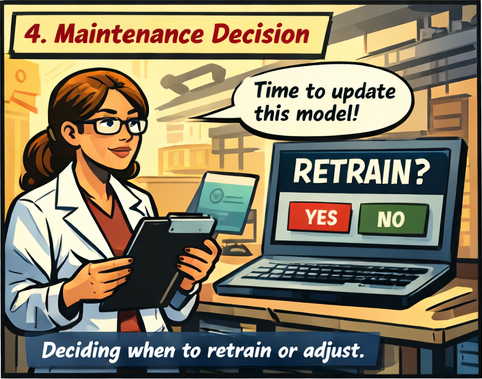
Not every change requires immediate action. Some variability is normal and expected.
STAMM helps distinguish between:
routine process fluctuations, and
meaningful changes that compromise soft sensor reliability.
When confidence drops below acceptable levels, STAMM users signal that maintenance is required — such as model validation, recalibration, or retraining — without prescribing how the model itself must be rebuilt.
Step 5: Supporting long-term operation#
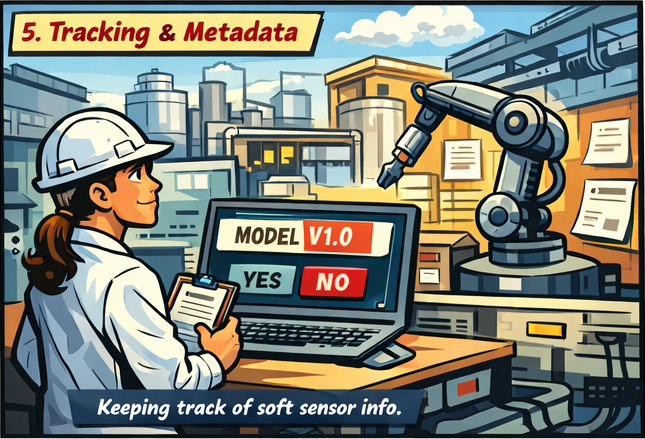
Over time, multiple versions of a soft sensor may exist, each valid under different operating conditions.
STAMM keeps track of this evolution, providing continuity and traceability across deployments.
In this way, STAMM acts as an operational layer between:
physical processes,
digital twins,
and data-driven soft sensors.
A note on metadata#
When a soft sensor is deployed, it does not exist in isolation. It comes with basic information that describes what the model is, how it was built, and how it is expected to be used. STAMM relies on this kind of practical metadata to manage deployed soft sensors in a consistent way.
In STAMM, metadata is limited to what is directly available from the soft sensor itself, such as:
model name, version, and identifier,
model type and architecture,
software environment and libraries,
input variables, units, and expected ranges,
output variables and scaling,
training setup and basic validation information.
This metadata does not attempt to fully describe the process or replace domain knowledge. Instead, it provides enough structure to:
clearly identify which soft sensor is deployed,
understand its expected inputs and outputs,
track different versions of the same model,
and support monitoring and maintenance decisions.
In simple terms, metadata helps STAMM answer basic operational questions such as
“Which model is running?”, “What data does it expect?”, and “Is this the same soft sensor as before?”
STAMM uses metadata as a lightweight but essential layer to support reliable deployment and long-term operation of soft sensors — nothing more, and nothing less.