How STAMM works
🔍 How does STAMM work?
STAMM describes the lifecycle of soft sensors once they are deployed in real industrial environments — reactors, fermentation tanks, production lines. It doesn't build the models; it integrates them, watches them, and manages them as operational assets.
The premise
In real industrial processes, some variables can be measured directly while others remain hidden, expensive, or physically impossible to observe continuously. Soft sensors estimate these unmeasurable variables from available process data. Once deployed, a soft sensor becomes part of the daily operation — similar to a physical instrument — but its reliability depends on assumptions that may change over time.
STAMM continuously monitors the behavior of the soft sensor in real time. Rather than assuming it remains valid indefinitely, it treats the model as a living component of the process: tracking whether incoming data remain consistent with previously observed conditions, how stable the operating environment is, and how the model's outputs evolve over time — similarly to how experienced operators detect subtle changes in a plant before formal alarms are triggered.
The five steps, illustrated
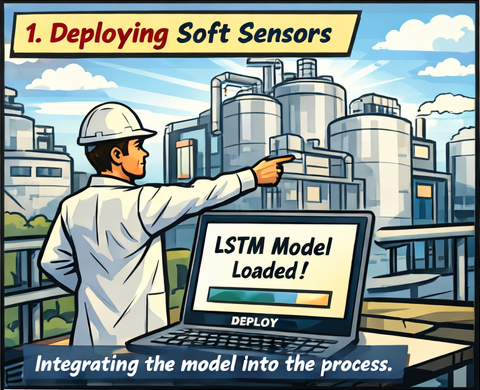
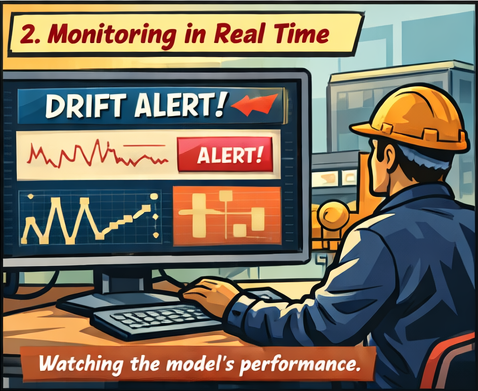
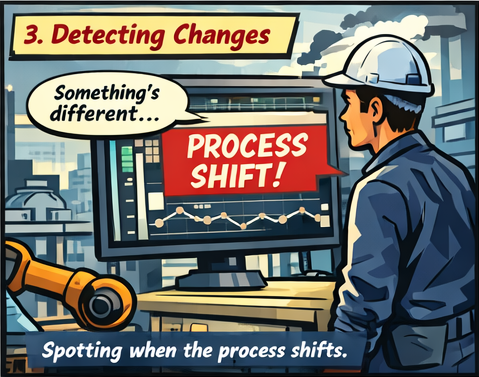
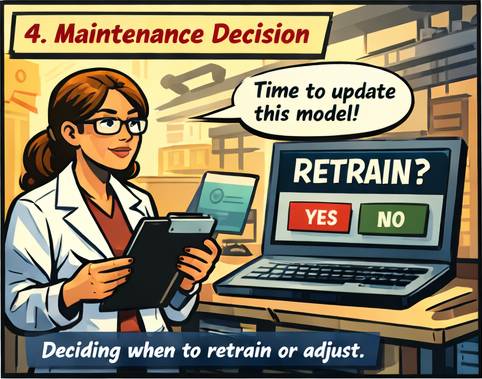
Drift, not noise
Industrial processes naturally evolve due to changes in raw materials, equipment aging, or updated control strategies. When such changes occur, the soft sensor may still produce outputs, but their reliability can degrade. STAMM identifies these situations by detecting shifts in operating regimes, gradual or abrupt process drift, and mismatches between current and historical operating conditions used during model development. From a digital-twin perspective, it ensures the digital representation stays aligned with the physical system.
Not every change requires intervention. STAMM distinguishes between normal process variability and significant deviations that affect model reliability. When confidence in the soft sensor drops below acceptable levels, it signals that maintenance is required — recalibration, validation, or retraining — without prescribing how the model should be rebuilt.
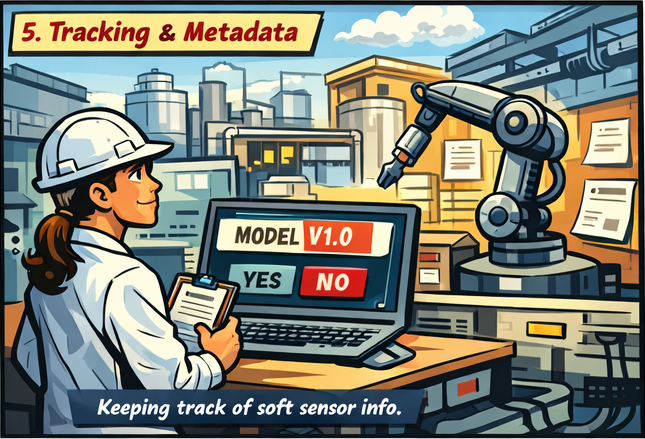
Over time, multiple versions of a soft sensor may coexist, each valid under different operating conditions. STAMM tracks this evolution to ensure continuity and traceability across deployments. In this way, it acts as an operational layer connecting physical processes, digital twins, and data-driven soft sensors into a unified monitoring framework.
A note on metadata
When a soft sensor is deployed, it does not exist in isolation. It comes with basic information that describes what the model is, how it was built, and how it is expected to be used. STAMM relies on this kind of practical metadata to manage deployed soft sensors in a consistent way.
- Model name, version, identifier
- Model type and architecture
- Software environment and libraries
- Input variables, units, expected ranges
- Output variables and scaling
- Training setup and basic validation info
- Clearly identify which soft sensor is deployed
- Understand its expected inputs and outputs
- Track different versions of the same model
- Support monitoring and maintenance decisions
In simple terms, metadata helps STAMM answer basic operational questions: "Which model is running?", "What data does it expect?", "Is this the same soft sensor as before?" — a lightweight but essential layer to support reliable deployment and long-term operation of soft sensors. Nothing more, and nothing less.