STAMM for Process Modelers
Process Modelers
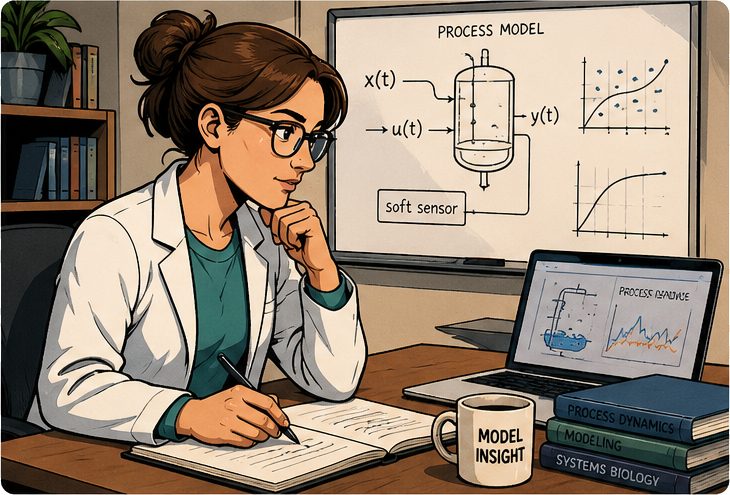
Experts in Process Engineering who design and validate soft sensors using mechanistic or hybrid models. They make sure predictions stay physically and biologically meaningful, and that the model's behavior still tells a coherent story as operating conditions evolve.
Why STAMM matters for you
A first-principles or hybrid model is only as useful as the conditions it was built for. Once it ships to a real reactor, the question is no longer "is the math right?" but "is the process still the one we modeled?"
STAMM gives Process Modelers a permanent observation post next to every deployed soft sensor — without forcing them to rebuild their modeling toolchain.
Watch hidden-variable estimates next to measured signals to confirm they stay in physically plausible ranges.
Distinguish ordinary process variability from regime shifts that invalidate model assumptions.
Every model version comes with input ranges, validation, and metadata captured in the registry.
Your journey with STAMM
Register the model
Upload your validated soft sensor — mechanistic, data-driven, or hybrid — to the Model Registry. Declare its inputs, outputs, expected ranges, training setup, and the operating window it was built for.
Validate against live process data
Use the Dashboard to compare predictions against measured variables, lab assays, and historical batches. Confirm the model still captures the dynamics that matter — feed-rate response, kinetic regimes, mass balance closure.
Watch for regime shifts
STAMM flags when current operating conditions drift away from the historical window the model was validated on. You decide whether the deviation is meaningful — substrate change, new strain, equipment update — or normal day-to-day variability.
Diagnose & iterate
When STAMM raises a maintenance signal, you have the full context: which inputs shifted, when, and how the residuals evolved. From there, decide whether to recalibrate parameters, retrain on the new regime, or extend the model structure.
Publish a new version
Register the updated model alongside its predecessors. STAMM keeps the lineage so older deployments remain traceable and the model history reads like a logbook of how the process actually evolved.
What you bring to STAMM
You bring the why — the physics, the kinetics, the assumptions. STAMM brings the when and the what now: live data, drift signals, and a place to keep your model versions ordered and observable. Together, that turns a one-off model into a long-lived industrial asset.